


The basis of every design: the technical drawing
Technical drawing is the creation of a construction drawing. It forms the basis for the craftsmen, according to whose specifications they manufacture the components.
Several years of training are required to be able to create a technical drawing.
The technical drawing must comply with the standard. This avoids misunderstandings. In addition to the shape of the workpiece, the drawing must therefore contain a great deal of other information.
What is a technical drawing?
The technical drawing is the generic term for all drawings according to which a component is manufactured, an assembly is mounted or another purpose is pursued with it. Technical drawings are therefore divided into the following groups:
- Component drawing
- Assembly drawing
- Overall drawing
- Illustration
The component drawing is the exact description of the individual components that make up an assembly.
This drawing is primarily used to manufacture the component. All relevant dimensions (dimensions, tolerances, surface specifications) are entered on the component drawing and ideally it leaves no questions unanswered.
The assembly drawing is used to represent a component in its environment. In the case of very large and complex designs, assemblies are always only a part of the overall structure. If necessary, dimensions are also entered on the assembly drawing. This is particularly important if individual components need to be adjusted for assembly.
The overall drawing shows the finished product. It is shown straight from all six sides as well as an isometric view – the “oblique view”. The isometric view gives a particularly vivid impression of the fully assembled product. Dimensions are also available on the overall drawing, but no longer in the depth of the component drawing.
The illustration is a simplified technical drawing. It is reduced to the essentials in its wealth of detail. Tolerances and surface details are completely missing in an illustration.
This technical drawing is only suitable for describing the assembly or use of a product. Illustrations are mainly found in technical documentation in which the assembly and use of a product is explained.
Technical drawing then and now
The history of technical drawing goes back to ancient times. Even the pyramids of Giza required prior planning and drawing before the first stone could be laid.
Technical drawing was thus itself a driver for the development of professional drawing tools. Paper, papyrus, ink, quills, rulers and compasses also had their origins in the need to be able to create a usable construction drawing.
Surprisingly, these very original methods of creating a technical drawing remained the same for thousands of years. Even the first moon rockets were drawn on paper before the first sheet metal was cut.
The development of the supersonic passenger aircraft “Concorde” is regarded as the starting signal for modern construction methods. It was not only the consistent use of CNC technology that was pursued with this project. Its construction was also largely carried out on the computer.
Since the early 1970s, digital design methods have therefore become increasingly important. The fall in the price of computing power and increasingly powerful programs also contributed to the fact that technical drawing is now practically only carried out on computers.
Creating a design drawing with paper and ink no longer takes place in any serious engineering office today.
Technical drawing: Properties
Despite modern working methods, the core of technical drawing has not changed. The printout creates an image that must be immediately recognizable as a technical drawing.
Otherwise, it is not legally valid and cannot be used as a basis for construction. This includes the following elements:
- Paper size A0 to A4 (A5 only in exceptional cases)
- Correct folding
- Frame
- Title block bottom right
- Specification of all dimensions in millimeters (without “mm” in the value)
- Perspective view from all relevant sides
- Correct use of hatching
- Consistent use of standard fonts
The exclusion of paper sizes smaller than A5 serves to maintain the legibility of a design drawing. Drawings that are too small would result in fonts, hatching and details no longer being recognizable.
The correct folding helps to ensure that even large drawings can be stored in standard folders. The frame serves to identify the image as a technical drawing and helps with open questions by providing dimensions and guide lines.
The uniformly placed and designed title block also serves to ensure that technical drawings always remain recognizable and usable as such. The basic measurement for technical drawings is “millimeters”.
There may be exceptions, but these must be well justified. The millimeter as a basic technical dimension is also to be seen as the minimum tolerance that a product must comply with.
This applies to both metal construction and general construction. The perspectives should be selected in such a way that the technical drawing has an optimum ratio of detail and display size. The fewer perspectives are shown on a sheet, the more space is available for the individual perspective and the more accurately a representation can be implemented.
For symmetrical components, such as bushings, seals, screws or pins, a single representation is usually sufficient. For asymmetrical components, on the other hand, at least two perspectives are required, ideally supplemented by an isometric view.
Hatchings are extremely important components for technical drawing. They provide a wealth of information such as sections, materials, roughness and other details. Finally, the uniform use of standard fonts ensures the legibility of all information on the construction drawing.
How to create a technical drawing that is accepted internationally is regulated in the EN ISO 7000 and ISO 128 standards, among others.
Dimensions for technical drawing
The dimensions are what distinguish a technical drawing from a picture, sketch or illustration. They are the most important and basic information that a construction drawing must contain.
There are therefore two basic rules for dimensioning that must be observed when creating technical drawings:
- Completeness
- Freedom from contradiction
Completeness means that a component is dimensioned with all its elements. Every distance, every diameter, every depth and every angle must be reflected in some form on the construction drawing.
If information is missing, this constitutes grossly negligent technical drawing, on the basis of which no satisfactory results can be expected. Contradiction-free technical drawing means that the details must not contradict each other.
The simplest case is that the external dimensions of a component must always equal the sum of the individual dimensions of one side. This is still quite easy to achieve with straight lines.
It can become more complicated if the outer edge is provided with angles. It is a common mistake to confuse the length of the hypotenuse with the projected outer edge, resulting in dimensional errors. A perfect understanding of geometry is therefore a basic prerequisite for creating technical drawings.
The way in which dimensions are entered in the technical drawing is regulated in DIN 5 and 6. However, today’s modern design programs hardly allow any incorrect dimensions to be entered on a design drawing.
Create the title block for a technical drawing
Creating a correct title block for a technical drawing is the most basic requirement for a successful design. It not only contains important framework data for the drawing itself, but also for its origin.
With this information, the mechanic knows who to contact in case of queries.
The title block for a technical drawing is structured as follows:
- Width always exactly 180 mm
- Any height and division
- Owner
- Part number
- Issue or creation date
- Title
- Authorizer
- Type of drawing
- Sheet number with indication of the total quantity
In addition, the following information is recommended for creating the technical drawing:
- Scale
- Version number/change index
- Leaf size
- Status (design, construction drawing …)
- Project name and number
The following information is required for individual part drawings:
- Material
- Shape and position tolerances
- Semi-finished product
- Weight of the finished workpiece
- Display and projection method
- File name for digital origin
A technical drawing that contains this information in the title block already eliminates a whole range of potential misunderstandings. The creation of the title block for technical drawings is defined in DIN EN ISO 7200.
Technical drawing with tolerances
The dimensions in millimeters are usually sufficient for the construction drawing of a building. However, a technical drawing for mechanical engineering requires much more precise information.
If the usual rounding methods are taken as a basis, a specification that is only accurate to the nearest millimeter would allow a deviation of + 0.4 to -0.5. Two components manufactured according to this precision specification would therefore differ from each other by up to 0.9 millimeters.
This dimension is no longer tolerable, even for the coarsest fits. Depending on the type of load, the tolerances for a workpiece can go into the thousandths of a millimeter.
Technical drawing takes this requirement into account by specifying tolerances.
The technical drawing contains information about the underlying tolerances at various points:
- Title block
- Direct specification on the dimension or surface
The classes of the so-called “general tolerances” are entered in the title block. They apply equally to the entire drawing. However, the tolerances depend on the dimensions of the component.
The longer a distance becomes, the higher its underlying tolerance becomes, regardless of the tolerance class in which the design drawing was produced. Letter abbreviations have been introduced to indicate this:
- f (fine): 0.05 – 0.2 mm
- m (medium): 0.1 – 3 mm
- c (coarse): 0.2 – 5 mm
- v (very coarse): 0.5 – 12 mm
A fine tolerance is required in precision engineering, for example by watchmakers. In most cases, however, this is not sufficient, which is why it must be supplemented with additional information at certain points.
The medium tolerance is common for general mechanical engineering. It applies above all to components that are not in contact with other components through fits. The large tolerance of 3 mm only applies to components over 4.00 meters in length.
The rough tolerance specification is particularly common for primary formed components that still need to be reworked. This primarily includes cast parts such as ingots or strands. The very coarse tolerance specification is no longer common in mechanical engineering today.
Even the coarse sand casting technique can already offer a tolerance that is at least in class c without great technical effort.
The tolerance classes are defined in ISO 2768.
For detail tolerances, the type of tolerance and its associated value must be specified. Specific tolerances are divided into“form and position tolerances“. Shape tolerances are as follows:
- Straightness
- Flatness
- Roundness
- Cylindricity
- Line profile
- Surface profile
There is an assigned symbol for each shape tolerance. This is entered next to the section to be dimensioned, if required.
The position tolerances specify how the individual elements of a component (bore, blind holes, shoulders, etc.) and surfaces must relate to each other. However, they do not specify the condition of the surface itself(roughness). Position tolerances are as follows:
- Parallelism
- Perpendicularity
- Defined angle(angularity)
- Position
- Concentricity/coaxiality
- Symmetry
- Concentricity
The presentation of this information is the same for position tolerances as for shape tolerances. The more detailed the technical drawing is when specifying the tolerances, the more precisely the workpiece can be manufactured later.
Technical drawing: Hatching
Hatching is particularly important for a technical drawing when sections or different materials are to be shown.
Hatching is therefore much more common on construction drawings than in technical mechanics. However, the correct use of hatching is just as important for technical drawings. Typical hatchings for technical drawings are as follows:
- Diagonal lines
- Diagonal grids
- Broken lines
- Parallel lines
- Circle hatching
Technical drawing uses diagonal lines with equal spacing whenever sections are to be shown. Sections are used to represent internal structures, such as steps, grooves or edges.
If the diagonal lines are always close together in pairs, the shaded component is a solid. Pairs of three diagonal lines represent metals.
If the outer lines of the diagonals are interrupted, the material is unalloyed steel. In the opposite case (outer lines are continuous and the inner line is interrupted), the material is alloyed steel.
Technical drawing of cast iron supplements the three continuous, parallel lines with a broken line in the gap between the groups of three.
Plastics are represented by grids. A continuous grid of diagonal, regular squares is generally used for all types of plastics. Thermoplastics, i.e. plastics that can be deformed under heat, are represented by a coarse grid, which is supplemented by four small crosses at each crossing point.
Thermosets, i.e. heat-resistant plastics, are symbolized by square patterns with groups of three closely spaced diagonal lines. Technical drawing represents elastomers, i.e. rubber, with falling diagonal lines with crossed short lines.
Media are important for a design drawing when flowing pipes or containers for liquid media are to be depicted. For this purpose, the technical drawing uses the parallel line as a basic design element.
To avoid confusion with dimension lines or outer edges on the design drawing, these parallels are subject to strict design rules. Liquids are always shown as broken lines.
The gaps in the broken line are always offset from each other. In the case of water, the parallel lines are always drawn in groups of three. The depiction of oil is an exception when depicting liquids for technical drawings: pairs of lines are used for this, where the lower line is continuous and the upper line is interrupted.
Grease lines, for example in lubrication systems, use continuous lines interrupted by circles for technical drawings. Finally, fuels are represented by parallel dash-dot lines.
Surface specifications for technical drawing
The information on the properties of a surface is particularly important for technical drawing for many applications. Typical examples of the need for this information are as follows:
- Fits
- Coatings
- Sliding and friction surfaces
With fits, roughness or other unevenness in a surface can lead to jamming. To avoid this, not only must all tolerances be correct, but the roughness must also meet the designer’s specifications.
The specification of a defined roughness is particularly important for coatings. If the surface is too rough or too smooth, this can lead to subsequent problems.
Chrome-plated surfaces require a mirror-like finish on the base material. Otherwise, the coating, which is only a few micrometers thick, makes any unevenness immediately visible.
When painting or powder coating, however, a defined, homogeneous roughness is advantageous for optimum adhesion of the primer and top coat. It increases the surface area and ensures better adhesion. The technical drawing must make these specifications visible.
It goes without saying that sliding surfaces should ideally be particularly smooth. If the specified roughness cannot be achieved by the machining processes themselves, grinding, polishing and lapping can achieve the desired results.
These three processes are also suitable for producing extremely fine tolerances. The implementation is a matter for the craftsman. However, their exact definition and standard-compliant specification must be provided by the technical drawing.
The surface specification for technical drawing is generally referred to as “roughness”. Its symbol is an angle with a short leg on the left and a long leg on the right.
The roughness is either entered directly on the symbol or replaced by a variable. The meaning of the variable must then be explained elsewhere in the technical drawing, for example in a table in the title block.
Technical drawing uses the letter R with the appendix Z for roughness. In the past, Rz or Ra could be used alternatively.
However, Ra is the arithmetic mean roughness value. This cannot capture extreme peaks in roughness, which is why it is unsuitable for technical drawing. There are four categories of roughness to choose from for technical drawing:
Rz4 – Rz6.3: Not visible to the naked eye
Rz16 – Rz25: Just visible to the naked eye
Rz63 – Rz100: Tactile and visible grooves
Rz160 – Rz400: Visibly coarse structure with broken edges
The numbers behind the Rz abbreviation stand for micrometers, i.e. one thousandth of a millimeter.
The finest roughness is achieved with polished, rubbed or lapped surfaces. The roughness up to Rz25 stands for honed or finished surfaces of lathes and milling machines.
Roughnesses up to Rz 100 are produced during simple broaching (rough turning), sawing or drilling. The coarsest surfaces are produced, for example, during sand casting or cutting with a cutting or plasma torch.
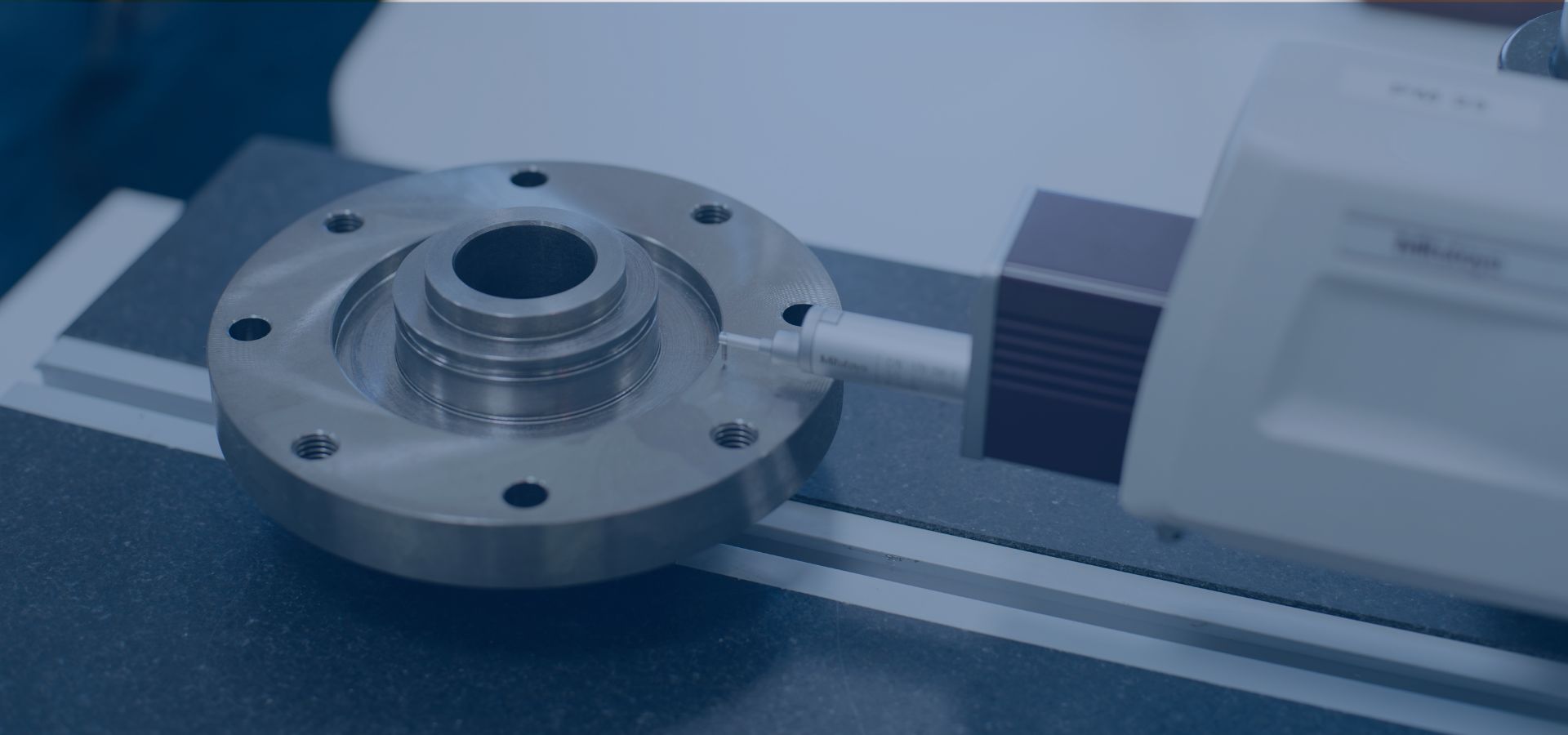
The touch probe is used to verify roughness. It uses a probe to precisely feel the surface profile and provides precise information about the surface quality.
Training for technical drawing
The traditional apprenticeship to become a “technical draughtsman” no longer exists today. The reason for this is that traditional drawing with a ruler, compasses and paper has practically disappeared.
Today, designs are only created on the computer. This has enormous advantages, making the use of traditional techniques superfluous. These advantages are as follows:
- Any scalability of all dimensions
- Immediate error correction and adjustments possible
- Multiple use of created components
- Highly accelerated mode of operation
- Simple derivation of rotatable 3D graphics from created page drawings
- Photorealistic texturing
- Creation of prototypes using 3D printing.
The scalability of a dimension or an entire design speeds up the creation of technical drawings considerably. Instead of laboriously erasing a sketch and redrawing it, most commands only require a few mouse clicks.
The same applies to error corrections or adjustments in the event of subsequent changes. Each technical drawing is saved in file formats that can be read by different programs.
A very convenient solution is that a technical drawing created in Inventor can be easily migrated to PDF, Corel Draw or AUTOCAD. Dimensions, surface details and hatching can be shown and hidden as required or replaced with alternative textures.
The modern programs are not only used to visualize a product. The files can even be read by production machines such as 3D printers. It is therefore no longer a problem to immediately convert the technical drawing into a tangible product.
Finally, high-quality programs can render the technical drawing into a photorealistic image and even convert it into a moving image in the form of a 3D animation.
This enormous facilitation, acceleration and multiplication of possibilities also have an impact on the learning content and responsibilities for an apprentice. It is therefore only too understandable that the traditional view of this profession is no longer congruent with today’s possibilities.
Today, trainees learn much more than just how to create a technical drawing. The job description of technical draughtsman has therefore evolved into “technical product designer” or “technical system planner”.
A school education of at least intermediate maturity is required for the apprenticeship. A good knowledge of mathematics is still a basic requirement. Above all, spatial, perspective thinking and a good understanding of technical contexts are very important in this profession.
Many trained technical draughtsmen choose to train as mechanical engineering technicians immediately after passing their final examination. They can apply the knowledge they have gained there directly and after 2-4 years (full-time or part-time) have a sound, in-depth education with many career and earning opportunities.
By completing the further training to become a state-certified mechanical engineering technician, the technical product designer will also have a technical college entrance qualification. This package is then an ideal prerequisite for studying mechanical engineering.
Create a technical drawing: A task for professionals
Even though technical drawing has become much easier today thanks to modern programs, it remains a task for qualified specialists.
A correct technical drawing is the basic prerequisite for successful production. The engineering office must therefore not skimp on the qualifications of its employees.