

Surface metrology
Surface metrology is part of quality control. It provides characteristic data on the fit, friction or coatability of a workpiece.
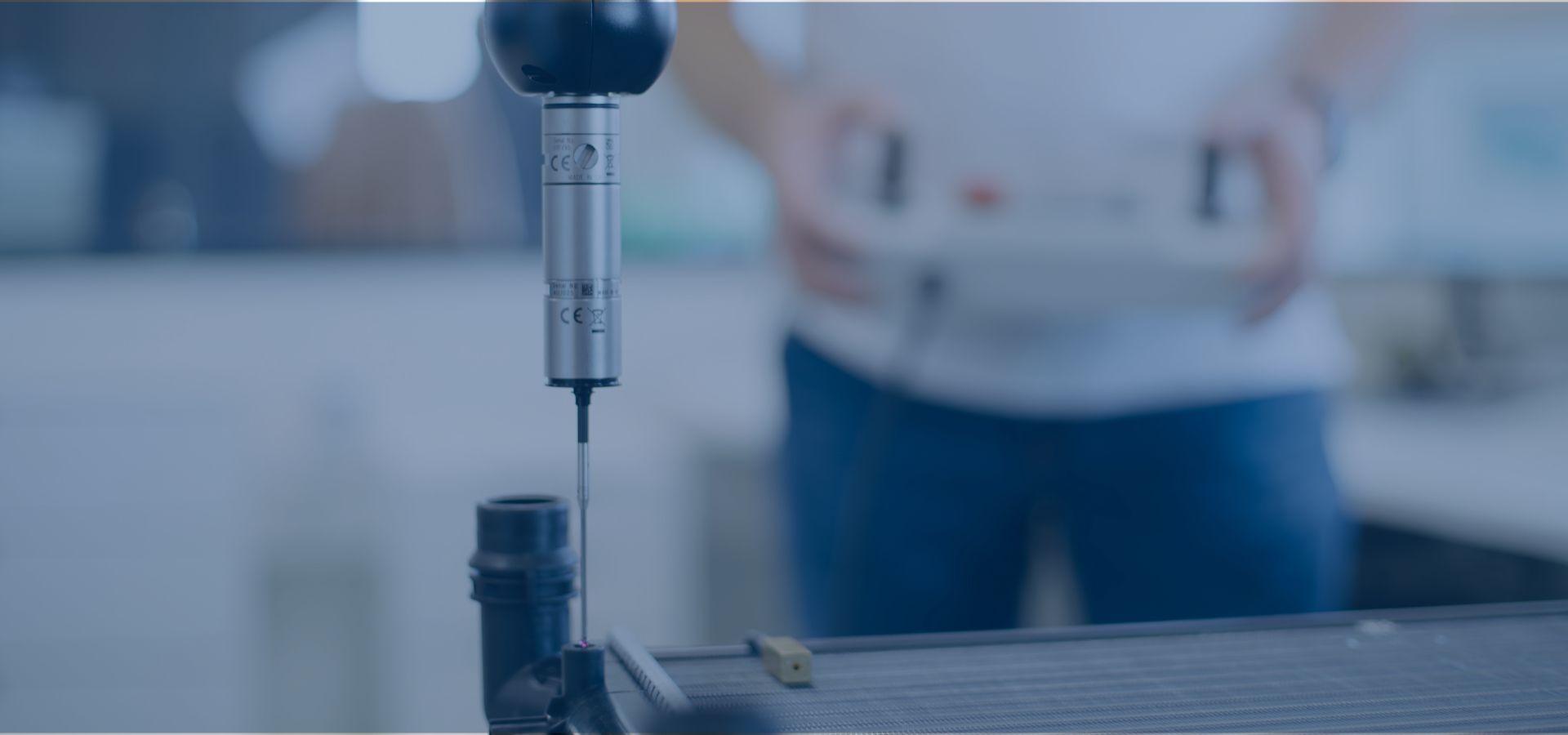
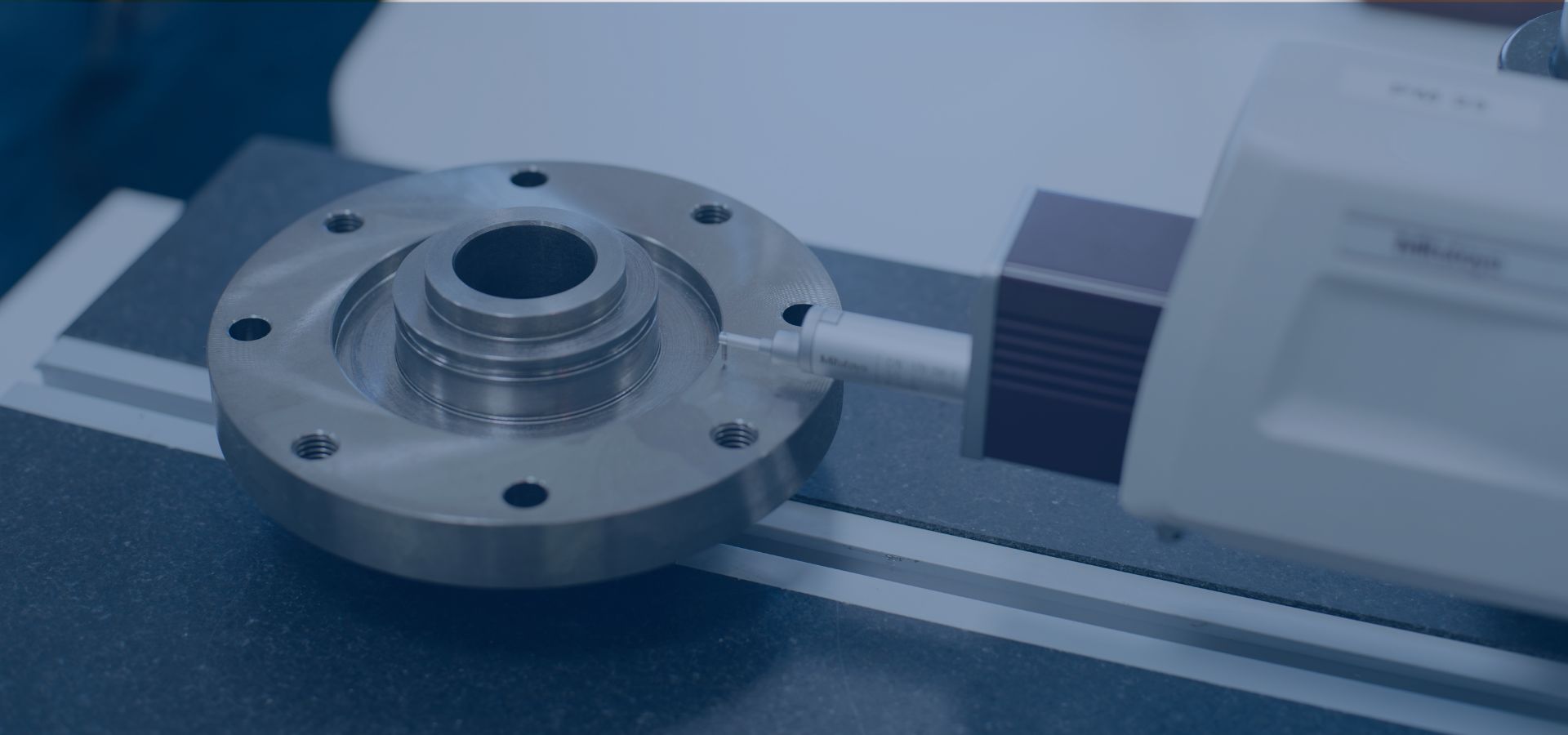
Particularly precise measurements of the surface are achieved using tactile measuring methods. The surface is scanned with highly sensitive probes to detect discrepancies with regard to tolerance deviations.
Determining roughness and waviness with surface metrology
The quality of a surface has a major influence on the quality of a workpiece. It is irrelevant whether the surface is rough, smooth or wavy. It must have the properties defined by the designer.
Deviations primarily affect the behavior of the workpiece in its interaction with other components. A surface that is too smooth reduces a defined coefficient of friction. This has an influence on the coatability of a product, for example.
However, if the surface is wavier and rougher than defined, the fit and sliding fit may deteriorate. The surface specifications are therefore entered on the drawing by the designer using standardized symbols and numbers.
The aim of surface metrology
The aim of surface metrology is to determine shape deviations of a workpiece on its outer sides. These shape deviations are defined as follows:
1. shape changes
2. Waviness
3. Roughness
The shape deviations examine a surface from “coarse to fine”. Shape deviations are visible damage or errors in the shape and position tolerances of components on a workpiece.
A bent, compressed or torsioned workpiece should be identified by surface metrology, as should incorrectly positioned holes, recesses or edges.
With modern 3D measurement technology, such defects can now be identified during production. A shape deviation of the first order can only be technically rectified to a limited extent. These identified production errors often end up as rejects.
The waviness is the shape deviation superior to the roughness. In the roughness profile, the amplitude of the deviations runs along the wave profile.
Since the transition from waviness to roughness is not defined, interpretation errors can occur when measuring roughness.
Ultimately, however, in most cases it does not matter whether a surface defect falls into the waviness or roughness profile category. Waviness can often be corrected by grinding. A popular method for determining tolerance deviations is tactile 3D measurement technology.
Finally, roughness is the finest gradation of shape deviations. It affects a workpiece in the micrometer range or below.
For its part, roughness is subdivided into further gradations which, in their finest form, extend into the molecular structure of a material. For most industrial applications, however, roughness measurement is relevant in the coarser ranges.
However, there are exceptions: The surface specifications of reflectors, for example from high-performance telescopes, can certainly extend into the molecular range. If the average roughness depth deviates from the defined surface specifications, it can usually be brought back to the desired level using suitable technical measures.
Grinding, polishing and lapping processes are available for leveling. Mechanical, thermal or chemical measures can be used to roughen a surface. The desired roughness of a surface is restored using coarse abrasives, laser light or harsh acids.
Determination of a surface structure
Simple measures are sufficient to identify first-order shape deviations. Micrometers, templates or simple visual inspection are sufficient to detect gross errors in shape and position tolerances.
3D coordinate measuring machines are available for more precise testing. They use defined measuring points to check the shape deviations and can therefore detect distortions, torsions and deflections.
Sophisticated measurement methods are required for waviness and roughness. Regardless of which surface metrology method is used, the aim of the measurement is always to identify the primary profile.
Rough and corrugated shape deviations are still combined in the primary profile. Once the primary profile has been determined, a suitable limit is defined at which the corrugated structures merge into the rough structures.
This allows the primary profile to be mathematically broken down into both parameters. The waviness refers to the distances between the wave peaks and the amplitudes between the wave peak and wave trough. The roughness profile runs along this wavy line and in turn has a peak-valley structure.
Characteristics of roughness measurement in surface metrology
Roughness measurement provides three relevant parameters for surface metrology:
- Center roughness value
- Square roughness
- Average roughness depth
The center roughness value refers to the average distance of the measuring point to the center line of the roughness profile. The individual distances are measured and divided by their number. This results in the arithmetic mean.
This mean value gives the average roughness value. The problem with determining the average roughness value is the waviness profile on which the amplitudes of the roughness are based. For this reason, the average roughness value is calculated twice in practice: First, it is determined within a small measuring section.
The length of this measuring section defines the subdivision of a larger measuring section that runs along the shaft profile. The measurement is then repeated within these defined sections.
The average roughness values of the individual sections are then divided by the number of sections. This results in an overall average roughness value for the measurement section. The symbol for the average roughness value is Ra.
Square roughness – an important measure in surface metrology
The quadratic roughness not only refers to the distance of a positive amplitude (wave crest) to a centerline, but also includes the wave trough. This is specified as a negative value.
If both values were simply added together, they would partially cancel each other out. In order to make it detectable for calculating the roughness, the negative amplitude is squared and the square root is taken from it.
For a simpler calculation, the same is done with the upper amplitude. The result is the quadratic roughness, which validates the mountain-valley course of a route in its entirety. The symbol for the quadratic roughness is Rq.
The average roughness depth is a method that is no longer used today. It is also referred to as the “ten-point height”. The average roughness depth is still indicated on older measuring devices. It is referred to as Rz.
Methods in surface metrology
There are two technical approaches to choose from in surface metrology:
The values determined can be displayed graphically with computer support. The resulting images are spatial representations of the surface profile.
Computer support can therefore be used to upgrade both the tactile and optical methods of surface metrology to 3D metrology.
Tactile methods in surface metrology are primarily the following approaches:
- 3D coordinate measurement
- Touch step method
3D coordinate measurement is used to validate larger surfaces and geometries. It is primarily used to determine shape and position tolerances. In this 3D measurement technique, a probe moves to a defined point on a surface and records its position.
Basic geometric shapes such as planes, cylinders, spheres, cuboids or pyramids only require a few measuring points to confirm the correctness of the surface data. Free-form surfaces require a larger number of measuring points.
However, 3D measurement technology using coordinates is not suitable for determining more detailed surface information. This is the domain of touch-step methods.
The touch probe method is a 3D measuring technique that is technically similar to the tactile coordinate measuring method. Here too, a measuring head moves over the surface of a workpiece.
The surface structure is analyzed very precisely with the help of a sensitive sensor system. The measuring principle is similar to the pick-ups of record players: the deflection of the probe is converted into an electromagnetic pulse via a coil.
This pulse is amplified and converted into digital information. However, the result of this surface measurement technology is always the primary profile. From this, the waveform and roughness are determined by breaking down the individual structures.
Optical methods in surface metrology
Today, increasingly advanced optical processes are available for checking surface details.
These can perform high-precision wave and roughness measurements and evaluate them plastically as 3D measurement technology. The following approaches belong to the optical methods of surface metrology:
- Laser scanning
- Stereo photography
- Stripe and pattern projection
- Confocal measurement technology
- White light interferometry
Although laser scanning is often used in film and television for three-dimensional effects, it is only a small part of surface measurement technology. It is well suited for the validation of large surfaces.
This puts it in strong competition with tactile 3D coordinate measuring technology. Classic laser scanning is often used for reverse engineering and the production of 3D graphics.
Corresponding devices are already available in the consumer sector and are popular with the maker movement and their 3D printers. However, they are in strong competition with simpler and, above all, faster processes. Laser roughness measurement, on the other hand, is not yet very widespread.
Digital stereo photography is a 3D measuring technique that is particularly impressive due to its simplicity and speed. In this process, a workpiece is simply photographed digitally from two angles.
The desired 3D model is calculated from the data and subjected to a target/actual comparison. However, stereo photography has so far only been used for checking shape and position tolerances. The same applies to fringe and pattern projection. It is very similar to stereo photography, but produces more precise data.
Finally, confocal measurement technology and white light interferometry are methods in surface metrology that enable deep insights into the structure.
In both methods, the surface is illuminated with a beam of light that is guided through an obliquely arranged, one-sided mirrored aperture. The light is reflected by the surface and redirected via the mirror at a right angle.
There it is again guided through a pinhole. Behind it is a photoreceptor. When the focal point of the light cone is exactly on the surface, the reflection is strongest. Any deviation causes the reflection to darken.
The connected software calculates the surface profile from these fluctuations in brightness. This in turn can be used to determine characteristic values such as waviness or average roughness depth.
Advantages and disadvantages of optical surface measurement
Optical surface measurement technology is clearly superior to traditional tactile methods in some respects. These include, above all, the speed with which measured values can be recorded. Equally important, however, is the universality of its applicability.
Tactile methods quickly reach their limits if the surface to be measured is highly porous, sticky or coated. The non-contact methods of optical surface measurement technology can even measure liquid or gaseous boundary layers of media.
However, tactile methods still have the advantage when it comes to the level of detail of surface information for solids. In particular, the roughness measurement of machined metal products is still preferably carried out using tactile methods.
However, optical surface measurement technology is subject to very high innovation pressure. It is therefore to be expected that non-contact, fast processes will completely replace tactile measuring methods.
This also makes it possible to integrate inspection procedures into production lines, which can perform a 100% inspection even for complex products and short cycle times.
The delivery of faulty parts to the customer is then a thing of the past. Optical surface metrology is therefore an important part of overall quality improvement.