


ISO 1302 – Standard for surfaces
DIN EN ISO 1302 is the standard commonly used in Germany for specifying the condition of the surface of a workpiece and how it is to be entered in a technical drawing and therefore falls within the area of surface measurements.
This standard has been adopted unchanged from ISO 1302 for Germany. Its name is “Geometric product specification (GPS) – Specification of surface finish in technical product documentation.”
The German version of EN ISO 1302 came into force in 2002.
It should not be confused with DIN 1302.
This standard says something completely different and has no relation to DIN EN ISO 1302.
As DIN EN ISO 1302 is identical in wording to ISO 1302, only the international title is used in the following text. This is to avoid confusion with DIN 1302.
Contents of ISO 1302
ISO 1302 specifies how the quality of a workpiece surface is defined and precisely represented in a drawing.
The central issue dealt with in this standard is“roughness“.
Properties of roughness
According to the ISO 1302 standard, the measured variables of roughness are the
- Roughness depth
- Average roughness depth
- Center roughness value
The roughness depth is the maximum value measured from a reference profile and a base profile.
The “reference profile” is the peak of the highest “mountain” of a rough surface. The base profile is the bottom of the deepest “valley” of a rough surface. This results in the roughness depth as the maximum value between the top of the hill and the bottom of the valley.
The roughness depth is abbreviated as “Rt” in accordance with ISO 1302, and the averaged roughness depth is an average value according to ISO 1302, which is determined using arithmetic methods from five selected, individual roughness depths.
It only gives a punctual indication of the condition of a surface. The average roughness depth is abbreviated as “Rz”
The center roughness value is an arithmetic mean value that is determined from all roughness depths of a surface around an imaginary center line. The center line is determined beforehand from the roughness depth. The average roughness value is abbreviated to “Ra”.
The standard also offers several other roughness measurement parameters. However, these three measured variables are the most important.
Roughness data
The roughness is specified by roughness coefficients in accordance with the standard. Only the average roughness values Ra are relevant for the specification in a technical drawing.
The roughness coefficients are defined with a preceding “N”. There are the key figures N1 to N12. They cover a range from Ra 0.025 to 50 µm
Typical roughness according to ISO 1302
The roughness of a workpiece results from the manufacturing and machining processes.
They can be seen as a consequence or are intentionally achieved in the desired way.
Typical roughnesses for production according to ISO 1302 are
Sand mold casting
Ra N10 to N12 – corresponds to a center roughness depth of 12.5 to 50 µm
Die casting
Ra N6 to N11 – corresponds to a center roughness depth of 0.8 to 25 µm
Drop forging
Ra N7 to N11- corresponds to a center roughness depth of 1.6 to 25 µm
Sheet metal deep drawing
Ra N4 to N9 – corresponds to a center roughness depth of 0.2 to 6.3 µm
Rollers
Ra N4 to N10 – corresponds to a center roughness depth of 0.2 to 12.5 µm
Cutting
Ra N7 to N10 – corresponds to a center roughness depth of 1.6 to 12.5 µm
Turning
Ra N4 to N11 – corresponds to a center roughness depth of 0.2 to 25 µm
Drilling
Ra N7 to N11 – corresponds to a center roughness depth of 1.6 to 25 µm
Milling
Ra N5 to N11 – corresponds to a center roughness depth of 0.8 to 25 µm
Loops
Ra N1 to N8 – corresponds to a center roughness depth of 0.025 to 3.2 µm
The average roughness depths Rz exceed the average roughness values Ra by a factor of 4-5!
The additional roughness index N0 was introduced for particularly fine sanding processes such as polishing or lapping.
It corresponds to an Ra of 0.008 to 0.006. The polishing range is not defined in the ISO 1302 standard. However, the following distinction can be made:
Stone polish: N9 to N7
Linen polish: N6 to N4
Diamond paste high-gloss polish: N3 to N0
Standardized terminology for processing and roughness depth
ISO 1302 proposes a precise terminological definition of surface roughness and its associated appearance:
- Unmachined, primary molded components (e.g. raw castings): No indication of roughness depth or angle with circle
- Roughened components: Grooves are visible and tangible: From Rz 100
- Finished components: Grooves are still visible: From Rz 25
- Finished components: Scoring is no longer visible, but the component is “matt”: From Rz 6.3
- Finely machined components: The component is shiny or reflective: From Rz 2
Drawing of the roughness depth according to ISO 1302
The complete, comprehensive roughness depth with all possible details is represented by an equilateral triangle standing on its apex with a flag attached to the right (extension of the right leg and horizontal line to the right) and five values. It looks similar to the mathematical symbol of the root.
The machining allowance is shown in millimeters at the bottom left next to the tip of the triangle.
At the bottom right next to the tip of the triangle is an indication of the nature of the surface in terms of grooves and the direction of the grooves.
An indication of the manufacturing process or surface treatment, including coating, is defined above the flag.
In the bottom right-hand corner is the general information on the nature of the surface.
The Rz value is shown below the flag.
If no grinding or polishing of the surface is planned, the two lines at a 60° angle to each other are sufficient.
However, the symbol must not stand alone, but must be further defined by the named information.
If the roughness of the surface is not critical and may correspond to the roughness typical for production, no further details are given. However, if it is to be emphasized that a surface does not require any additional machining, a circle is inserted in the angle.
Professionals generally prefer precise information that they can refer to in case of doubt. Theoretically, a missing specification can always be “forgotten”, so that a lot of time is lost due to queries. This can be avoided by providing comprehensive details of all relevant specifications on a drawing.
If the surface area specification applies to the entire enveloping surface of a component, an additional circle is appended to the surface area specification.
Pay close attention to the position of the circle so that it is not confused with the symbol for the “unbroken surface”: In this case, the circle is positioned exactly in the angle between the leg and the flag.
When specifying the roughness depth, it must also be stated which measurement parameter (Ra or Rz) is used.
Grooves according to ISO 1302
ISO 1302 specifies exactly how a grooved surface is to be entered on a drawing. Grooved surfaces are accepted or desired, strong roughnesses.
A groove differs from the general roughness by its uniform direction. They can be arranged linearly or radially.
Symbols for the groove direction:
M : Multiple groove direction – the grooves have no fixed direction: lapped and other finely finished surfaces
C: Concentric groove direction – the grooves are circular, as they occur, for example, when turning the front edge of a turned part.
R: Radial groove direction – the grooves describe one or more arcs
X: Crossed groove direction – the grooves are straight and cross each other (e.g. when honing a liner)
? Vertical groove direction – the grooves are straight and perpendicular to each other
P: Plan – no grooves
=: The grooves run parallel to the projection plane (planing method)
Position of the symbol
The shape of the symbol was chosen so that it can touch the surface to be worked on precisely with its tip.
It is always rotated in the direction of the surface to be processed or is perpendicular to it. The information is also rotated according to the direction of rotation of the symbol.
Checking the roughness
ISO 1302 does not specify how roughness is to be checked. It is only intended for pictorial representation in a technical drawing.
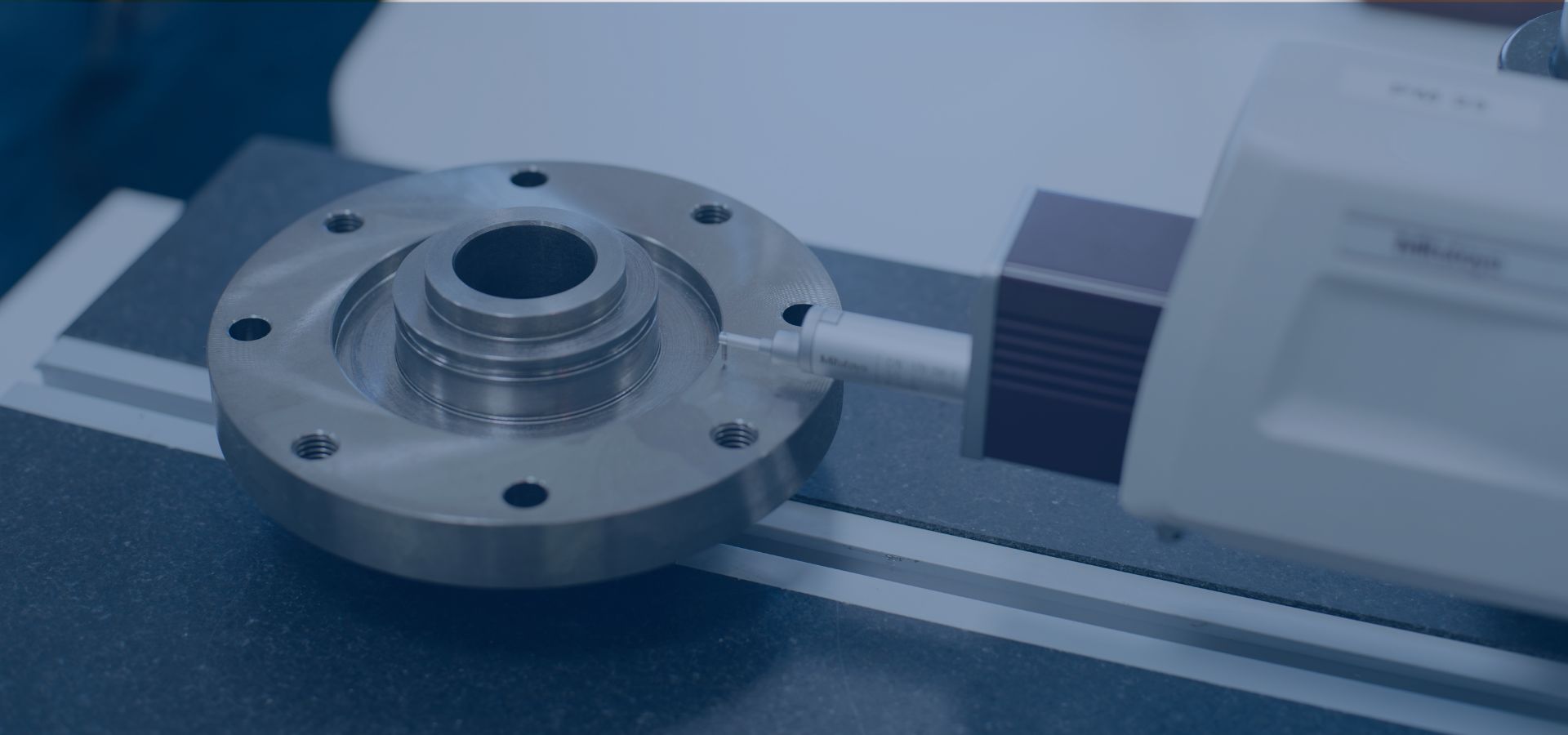
However, DIN EN ISO 4288 specifies the stylus method for measuring roughness.