

Standard for surfaces
DIN ISO 4287/1 is the standard for the designations, definitions and parameters of surface quality with regard to average roughness depth.
Together with DIN EN ISO 4288, it forms the standard for Geometric Product Specifications (GPS) and the application of the stylus method.
DIN EN ISO 4288 supplements DIN ISO 4287/1 with the rules and procedures for assessing surface quality.
Surface standards with average roughness depth
The DIN ISO 4287/1 standard defines the cuts and profiles that a surface profile can have.
In addition, a series of parameters are defined which describe the surface profile in vertical, horizontal or a combination of both directions.
The characterization of the geometric structure of the respective profiles comes from the primary profile, the roughness profile and the waviness profile. The question of practical suitability in industry is not taken into account, but a purely empirical determination of the parameters is made.
In order to make the parameters specified in DIN ISO 4287/1 suitable for practical use, the methods specified in ISO 4288 are recommended. DIN ISO 4287/1 thus has the status of a “standard for understanding” rather than for specifying manufacturing and testing methods.
The stylus method in the average roughness depth
The stylus method uses a measuring device to analyze and describe the structure of a surface.
It is of great importance in roughness measurement and is therefore explicitly mentioned in the standards DIN ISO 4287/1 and ISO 4288. Alternatives to the stylus method include laser scanning or photographic methods.
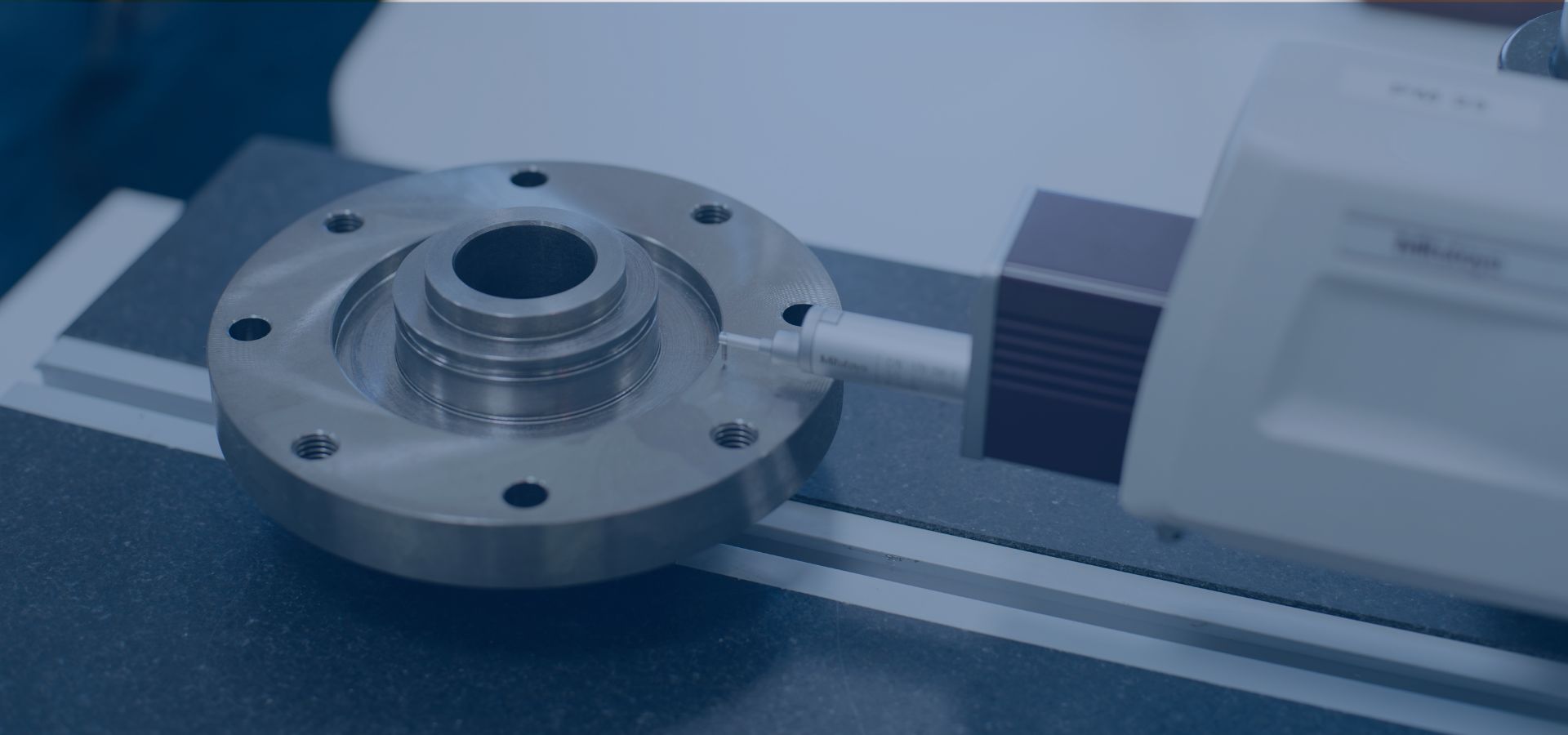
The stylus method works with mechanical-sensory stylus devices, called “perthometers” in roughness measurement. A probe with a diamond tip is guided over a surface to be examined.
With the help of simple levers and connected distance sensors, the microscopic elevations can be converted into measurable quantities without any loss of accuracy.
While maintaining a constant speed, the actual actual surface is recorded by sensors and can be analyzed, graphically displayed and evaluated by a computer system.
Modern devices usually output the standardized roughness parameters automatically.
According to DIN 4768, the roughness parameters are differentiated as follows:
- Center roughness value
- Single wheel depth
- Average roughness depth
- Maximum roughness depth
The average roughness value RA is an arithmetic average value that is calculated from the distances of a roughness profile from the center line within a measuring section.
The individual wheel depth Zi is the distance between two parallels that touch the highest and lowest points along the center line within the individual measuring section.
The average roughness depth Rz uses five adjacent, individual measurement sections. From this, it determines an arithmetic mean value.
The maximum roughness depth Rmax is the largest measured amplitude within an entire measuring section.
Formation of the average roughness depth
The average roughness depth is abbreviated Rz. It is also called “ten-point height” due to its measurement method.
It is determined by dividing a defined measuring section into seven individual, consecutive measuring sections.
The processes used in the stylus method require the two additional, outer measuring sections for the Gaussian distribution, but these are ignored in the further course of the measurement. Therefore, only the five measuring sections in the middle are relevant for determining the average roughness depth.
Each individual measurement section is then analyzed according to its maximum and minimum value. The values are subtracted from each other. The result is the respective individual roughness depth.
The average roughness depth is now the mean value of these five individual roughness depths. As one “peak” and one “valley” are determined along each of the individual sections, a total of ten points are required to measure the average roughness depth.
This gave rise to the additional name “Zehnpunkthöhe” (ten-point height), although this is not the best choice with the restriction “height”.
Average roughness depth in practice
The average roughness depth is used in practice for the qualitative measurement of bearing surfaces and sliding surfaces.
It also plays a major role in fits, especially when they are press fits.