

Everything the eye can see
The “macroscopic examination” is the examination of the surface of a workpiece with the naked eye.
It provides only a few valid measured values, but gives a good assessment of the manufacturing process of a product and its environmental conditions.
From this, certain conclusions can be drawn about its suitability for use or its service life. The macroscopic examination precedes the microscopic analysis.
Origin of macroscopic properties of a surface
The surface of a material depends on its microscopic structure down to the atomic level. The same environmental conditions or manufacturing processes can have very different effects on different materials.
Therefore, the effect that an external influence has on a material is always directly dependent on its composition and manufacture.
Even chemically identical materials can behave completely differently in the short to long term, depending on how they are processed.
Cast steel, rolled steel or hardened case-hardened steel can come from the same melt. If they are exposed to the same environmental conditions, they will develop differently.
What can the macroscopic examination achieve?
The macroscopic examination can only examine the visible and tactile surface of a base material.
Aids are permitted as long as they do not visually enlarge a section of the surface.
Typical fields of investigation for macroscopic examination are:
- Dimensional checks
- Checking the flatness, roundness and angularity of a workpiece
- General statements about roughness
- General statements about and grooving
- Detection of shells, grooves, notches and holes
- Damage due to corrosion and other chemical or physical causes (e.g. bluing of steel under temperature)
- Detection of hairline cracks (e.g. dye penetration test)
- Detection of damage due to breakage, impact and bending
- Detection of dents in smooth surfaces
Dimension and geometry
The simple checking of dimensional accuracy using calipers, rulers, measuring tapes or micrometers is generally also classified as macro examination.
For flatness, roundness and angularity, simple manual tools such as gauges or protractors can also be used.
Roughness
Roughness can be examined macroscopically by touch and sight. The roughness of a surface can be classified with the naked eye.
A surface is considered “rough” if it has a roughness depth of Rz 5 – 8 µm. It is considered “smooth” if the roughness depth Rz is less than 1 µm. Roughness can be checked and analyzed quickly and easily using surface measurement.
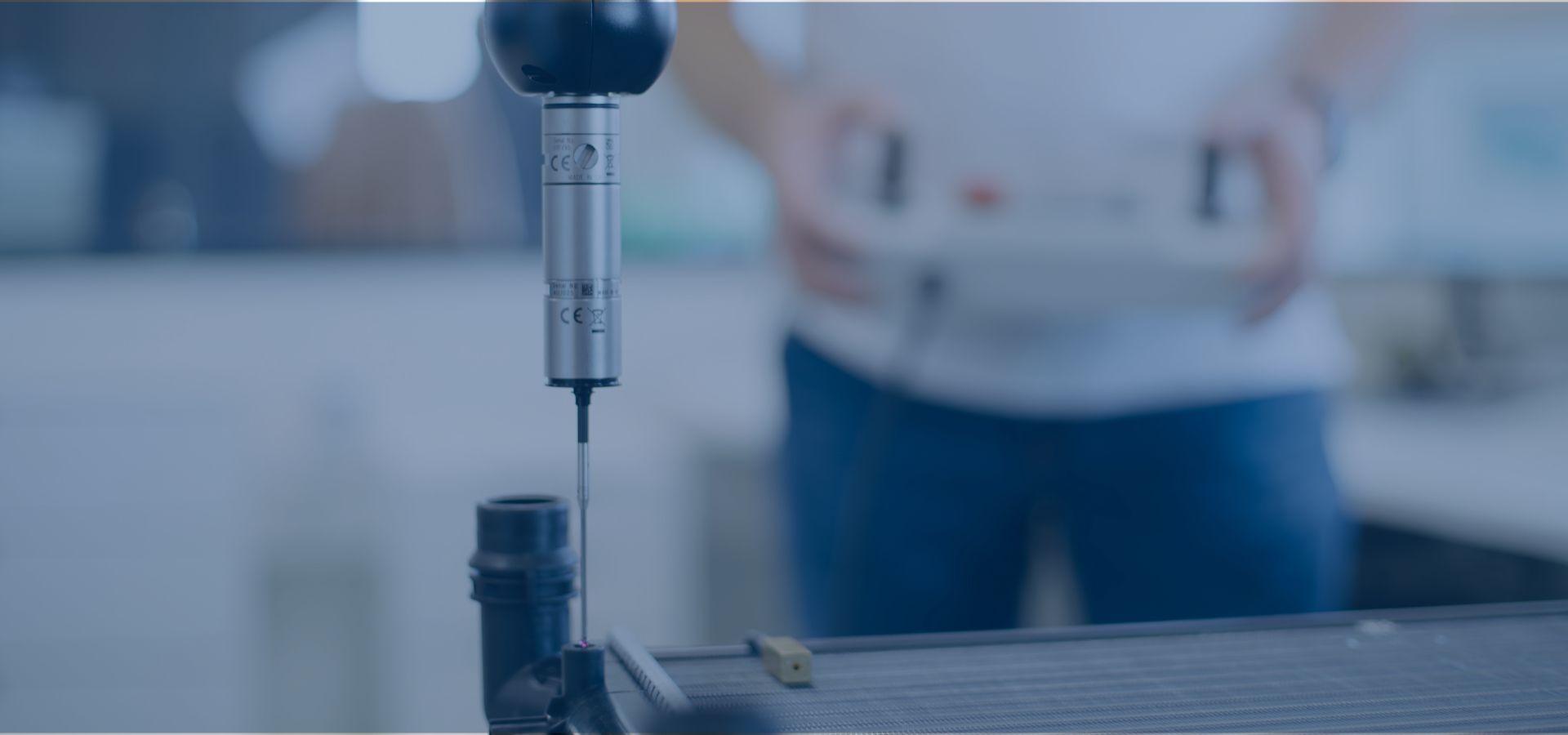
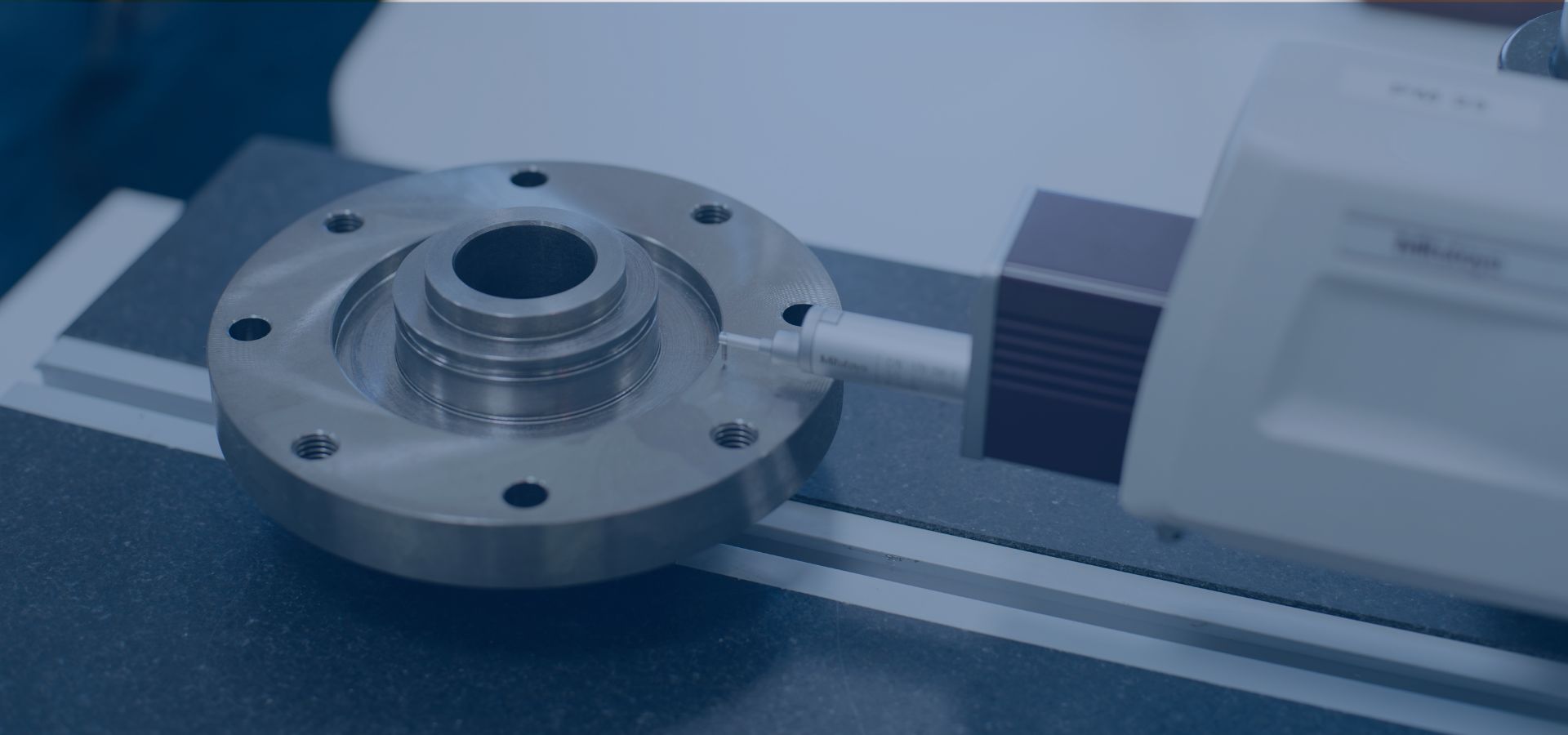
The most precise method for analyzing surfaces is tactile measurement technology. Highly sensitive probes scan the component to detect deviations from the permitted tolerance.
The exact roughness depth cannot be determined with the naked eye. However, general statements can be made as to whether a surface is “smooth” or “rough”. Based on empirically measured data, a rough estimate of the roughness depth of a surface can be made.
Surfaces of cast and forged parts
Matt, structure has no order or direction. Roughness depths approx. 12.5-50 µm
Deep-drawn sheet metal parts
Matt, perceptibly smooth, very thin-walled products, usually made of aluminum or plastic. Roughness depth 0.2 – 6.3 µm
Rolled sheets
Noticeable roughness, irregular, parallel lines, varying in width. Roughness depth up to 12.5 µm
Machined surfaces
Smooth to slightly rough. Parallel or concentric lines, consistent in width. Roughness depth up to 25 µm
Polished surfaces
Matt to slightly glossy, smooth, visible sanding lines. Roughness depth up to 3.2 µm
Polished surfaces
Smooth and high-gloss. No visible sanding lines. Roughness depth up to 0.008 µm.
Grooving
The type, direction, depth and cause of the grooves can be quantified by macroscopic examination.
Depending on the experience of the tester, a statement can be made about how the grooves affect the technical properties of the workpiece.
Shells, notches and holes
Shells are usually detachable, rolled-in layers in a surface. Notches are indentations caused by foreign bodies or damage to the roller.
Holes are torn out areas. These damaged areas, which are particularly common in rolled sheet metal, are a typical area for macroscopic examination.
In addition to the empirical determination of these defects, statistical surveys are also useful for identifying trends in the development of quality in series production.
Corrosion and other external influences
A material changes no matter what environment it is exposed to. The influencing factors are
- High temperature fluctuations
- Acids or bases
- Moisture
- Adhesions
Contact with other components (abrasions, impacts, etc.) A qualified macroscopic examination can provide quick and accurate information about the condition of a workpiece and make predictions about its further usability.
Detection of hairline cracks
A hairline crack is not usually visible to the naked eye. However, it can be detected using a simple procedure without the need for a microscope.
The dye penetrant process uses the capillary effect of a hairline crack to initially absorb the dye.
When subsequently applied with a contrast agent, the color runs out of the hairline crack and clearly indicates its size and position. However, its depth cannot be determined using this method.
Detection of mechanical damage
Mechanical damage such as breakage, impact or bending leave typical marks on the surfaces.
A qualified macroscopic examination can make an exact statement about the type of damage based on the damaged area. Typical types of damage are
- Shear fractures
- Demolition
- Fatigue fracture
- Explosion cracks and much more.
Detection of dents in smooth surfaces
The striped reflection method can be used to detect dents in painted, chrome-plated or polished surfaces. To do this, a striped indicator plate is held over the suspected dent.
The reflected stripe pattern clearly shows the no longer parallel, but curved course in the object to be examined.
This process is often used for the fine machining of sheet metal. It can eliminate the need for time-consuming grinding work and recoating through careful dent removal.
Macroscopic examination in destructive material testing
The methods described are primarily suitable for non-destructive material testing. They apply to all products and their surfaces that can be removed from and re-added to a production process.
However, the macroscopic examination can also go into greater depth. However, this always requires the destruction of the sample.
Possible examinations are:
- Blowhole detection
- Proof of segregation
- Analysis of rolled sheets
Blowhole detection
Blowholes are cavities that can occur during welding and casting. Blowholes can appear during normal reworking, such as turning or milling off a surface.
However, they can also be specifically detected by sawing or gradually abrading a sample. Investigations of this kind are used to optimize a manufacturing process.
Proof of segregation
Segregations are segregations that can occur during a rolling process.
A component of an alloy, such as carbon, collects in a segregation and becomes visible as a clearly visible line in the cross-section of a cut and ground sheet. The sample can also be etched for better visibility.
Analysis of rolled sheets
With the so-called drop hammer test (DWT test), a sample of a metal sheet is broken through widthwise. The crystalline structure at the fracture edge can be seen with the naked eye.
Destructive material testing also includes numerous other methods for macroscopic testing
What the macroscopic examination cannot do
A macroscopic examination can make general statements about the properties of a workpiece indirectly using simple means.
The density can be determined from the mass and volume, which in turn allows conclusions to be drawn about the material. However, this is only really practical for coated materials, as the material cannot be seen.
Simple tactile examinations allow conclusions to be drawn about elasticity. In the macroscopic range, however, these conclusions remain very limited.
The macroscopic examination can:
- only make very limited statements about the exact chemical composition of a material
- can only make very limited statements about the formation of cavities inside a workpiece by non-destructive means.
Using simple indicators (magnetism, rust formation…), it is possible to say something about the composition of a material in a very general macroscopic way. However, without additional tools, these analyses are of little value.
In principle, however, the macroscopic examination is the start of a complete analysis of a workpiece or material, depending on the issue at hand.
With a qualified and complete macroscopic examination, a subsequent microscopic examination can in many cases be carried out much faster and in a more targeted manner.