

Always as smooth as required thanks to the correct surface finish
Metal can be polished to a mirror finish. This completely eliminates the roughness of the surface. Even the tightest tolerances can be maintained with a polished or lapped surface. However, producing a mirror-smooth surface is very time-consuming and makes a component correspondingly expensive. In many cases, a maximally smooth surface is also undesirable. A component often needs a defined roughness depth to improve handling. The surface roughness is therefore a parameter that must be defined on the component drawing.
Definitions of surface roughness
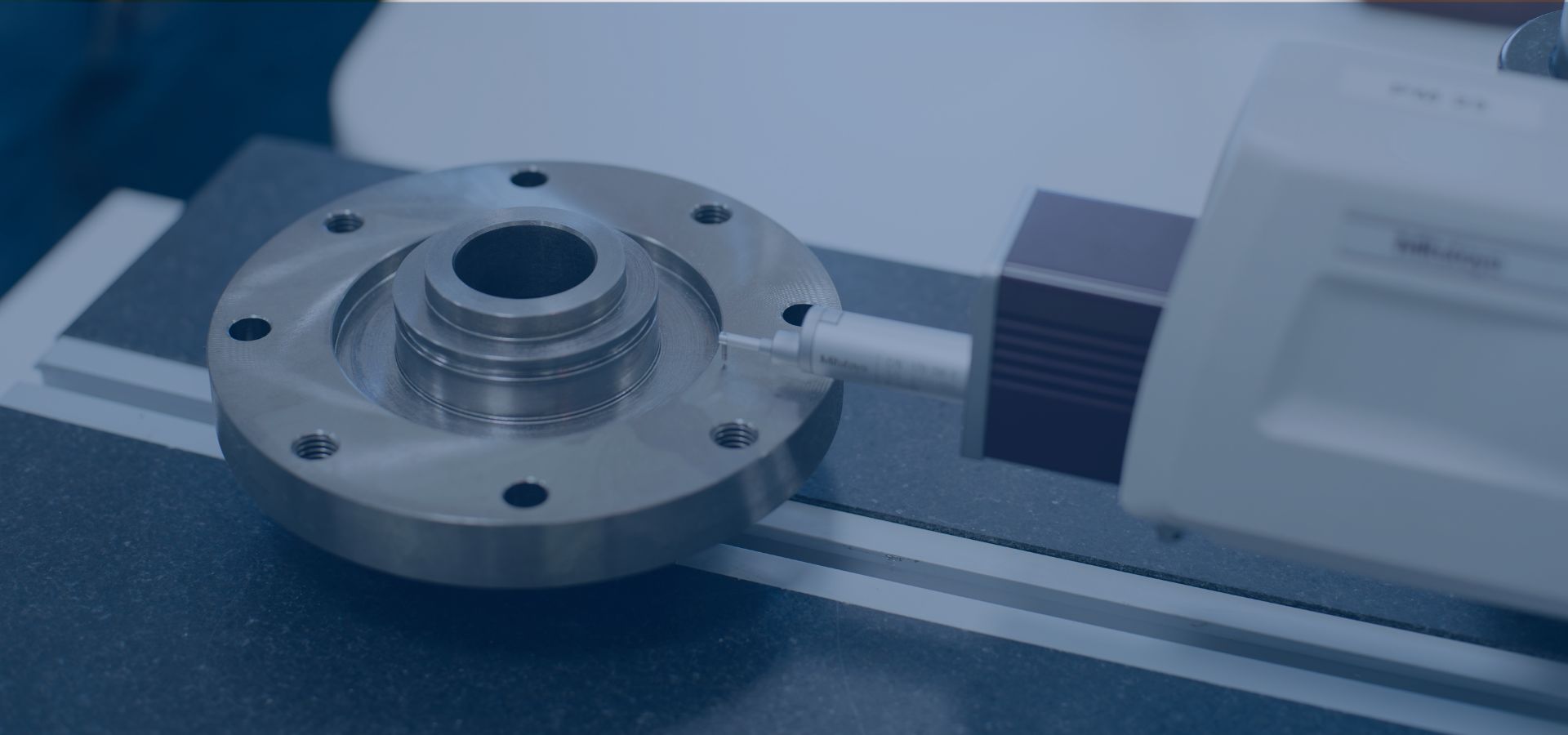
The roughness of a surface can be measured. Standardized methods and specifications are available for determining it. This means that the roughness of a surface can be specifically determined by the worker.
The roughnesses are described in the EN ISO 25178 standard. Their representation is defined in the DIN EN ISO 1302 standard. A distinction is made between the following two types of roughness:
Ra = Average roughness value
Rz = Average roughness depth
The average roughness value Ra is determined as the mean value of the deviations along a center line.
The average roughness depth is calculated as the mean value from the measured roughness depths. Ra and Rz are given in um.
The following average roughness values (Ra) are typical for certain surfaces:
- Hot or cold box sand casting: 12.5 – 25 um
- Kukillen continuous casting: 3.0 – 12.5 um
- Mold die casting: 0.8 – 6.3 um
- Longitudinal turning: 0.2 – 3.2 um
- Facing: 0.4 – 6.3 um
- Milling: 0.6 – 3.2 um
- Sanding/polishing: 0.012 – 0.4 um
- Lapping: 0.006 um
As an alternative to the Ra/Rz values, the “roughness grade” is also commonly used. This is represented by the letter N and the numbers 1-12. N1 has a roughness value of 0.25 um, N12 is very coarse at 50 um.
Applications for defined surface quality
The required surface quality always depends on the respective application. Polished surfaces are a prerequisite for chrome-plating steel products, for example. Roughened checker plates are the standard for steel stairs, landings and steps, as they guarantee the best slip resistance. Lapping, on the other hand, is only required to achieve the tightest tolerances.
Representation of the surface quality
The quality of the surface must be entered on the technical drawing. The basic symbol for this is an acute angle with legs of different lengths. Untreated surfaces are shown with this angle and a circle at the tip of the angle. No further details are required in this case. If, however, a defined roughness is to be produced on the surface, the apex of the angle is closed by a straight line to form a triangle. The roughness information is entered via this triangle. The specialist draughtsman has three options for this:
- Specification of roughness with type (e.g. Ra3.2)
- Specification of a from-to tolerance (the roughnesses are noted on top of each other for this purpose).
- Specification of the degree of roughness N1-12