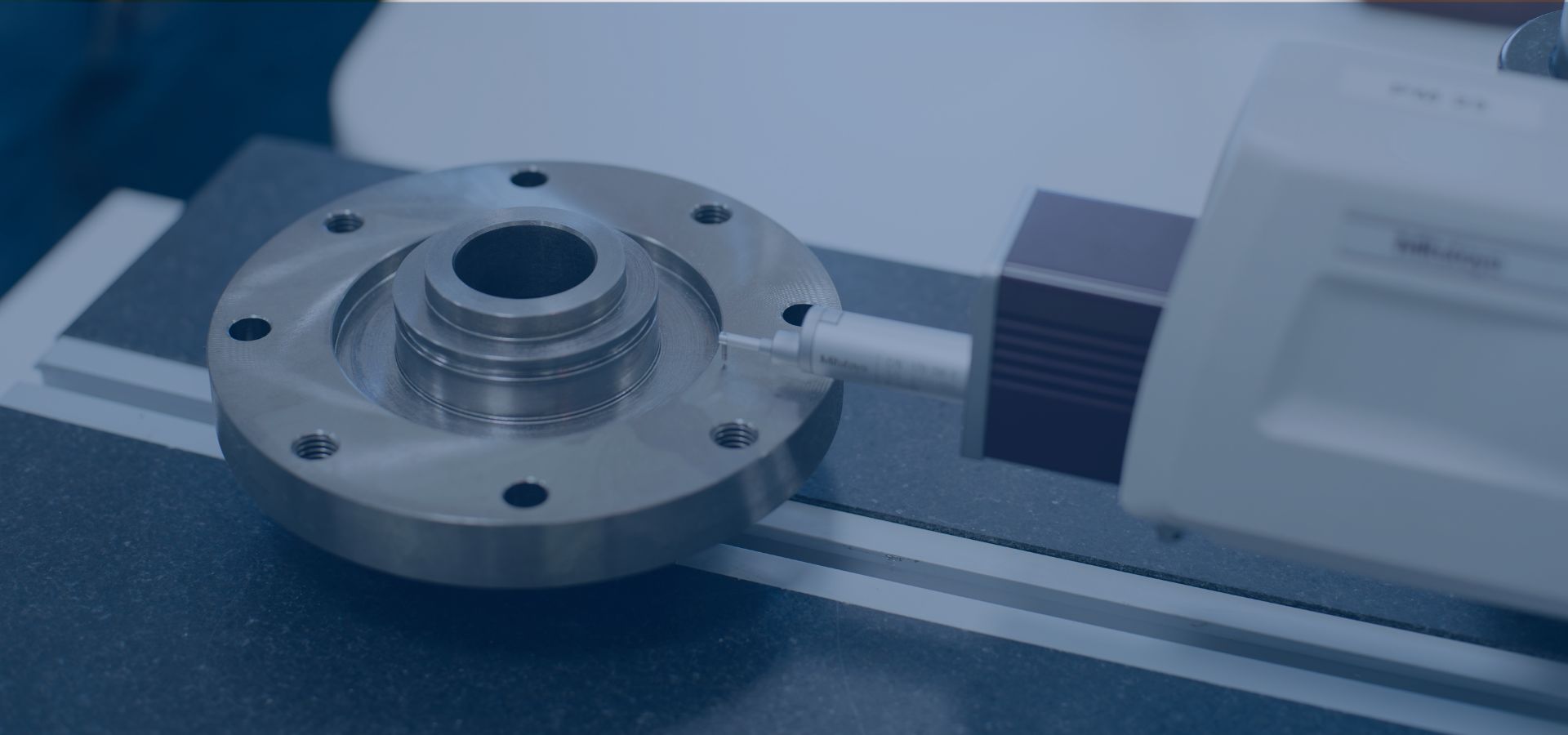


Shape and position tolerances
Form and position tolerances describe deviations from the ideal workpiece geometry that cannot be determined by measuring a single workpiece position, as is generally the case with dimensional tolerances.
A shape tolerance is, for example, an indication of the maximum permissible deviation of a shaft cross-section from the circular shape, a position tolerance is the maximum value by which the axis of a bore may deviate from the specified ideal position.
Why are shape and position tolerances necessary?
Shape and position tolerances are initially required due to unavoidable deviations from the ideal workpiece geometry that occur during production.
Causes for such deviations in shape and position are, for example:
- Elastic deformation due to clamping of the workpiece during machining
- Flexibility of the tool holder
- A changing cutting force due to the workpiece geometry
- Machine vibrations
- Residual stresses in the workpiece
Another reason for specifying shape and position tolerances is that measurements cannot exactly reproduce the workpiece geometry. In addition to the manufacturing tolerances, measurement tolerances must therefore also be taken into account.
The importance of shape and position tolerances
Production-related deviations from the target shape and position can impair the function and interchangeability of workpieces and assemblies, even if the dimensions are within the limits specified by the dimensional tolerances.
In order to specifically compensate for such deviations, processes such as tool correction are used in industrial practice, which digitally adapt the tool geometry on the basis of real component deviations.
Conversely, it is also possible that deviations in shape and position do not affect the function of a workpiece at all, even though they are outside the dimensional tolerance.
In such cases, the explicit specification of suitable shape and position tolerances can reduce the proportion of rejects and thus cut production costs.
In the mid-1980s, this led to a fundamental revision of the standards relevant to form and position tolerances and a change in the so-called tolerancing principle.
The relationship between dimensional, shape and position tolerances
According to the new tolerancing principle introduced in 1985 with DIN ISO 8015, form and position tolerances apply independently of each other and also of the dimensional tolerances.
This is in contrast to the old tolerancing principle described in DIN 7182 from 1971 and DIN 7167 from 1987. A significant difference between these two principles is that in the new regulation according to DIN
EN ISO 8015, only form and position tolerances that are explicitly documented still apply. In technical drawings of older origin whose tolerance specifications refer to DIN 7182 or 7167, on the other hand, implicit requirements for form and position tolerances must also be observed.
Deviations in shape or position must be within the dimensional tolerances, unless expressly specified otherwise.
To ensure that this important difference is clearly recognizable, the use of the new tolerancing principle must be indicated in the title block, for example by stating “Tolerancing ISO 8015”.
For drawings created according to the old tolerancing principle, no such reference is necessary, as otherwise all old documents would have had to be changed with the introduction of ISO 8015.
However, to avoid misunderstandings, especially in international data exchange, a reference to tolerancing in accordance with DIN 7167 can also be entered.
This standard essentially summarizes the content of DIN 7182 in connection with the
introduction of ISO 8015 and is not intended for new designs.
General tolerances for the simplified specification of form and position tolerances
The ISO 8015 requirement that all form and position tolerances must be specified in the drawing would quickly lead to an overload of technical drawings with tolerance specifications without further specifications.
For this reason, the DIN ISO 2768 T1 standard, for example, specifies general tolerances with values in four tolerance classes: fine, medium, coarse and very coarse.
They can be indicated by the abbreviations f, m, c and v. This means that a drawing or other document only needs to indicate the use of the standard and the selected tolerance class for length and angle dimensions, as well as any deviating form and position tolerances.
How are shape and position tolerances specified?
The principles for dimensioning form and position tolerances in technical drawings are specified in the DIN ISO 1101 and 5459 standards.
The first standard defines terms, symbols and different ways of entering form and position tolerances on workpieces or assemblies. The second standard deals with references and reference systems for form and position tolerances.
The standard defines a reference as an ideal, geometric element on a workpiece to which the form and position tolerances refer. The position of the reference on a workpiece defines a single or a group of reference elements.
These are real existing elements of the workpiece, such as machined edges, surfaces or holes. The number of reference elements that form a reference should be kept as small as possible. Preferably, a single reference element or a maximum of two should be used.
The use as a reference element can place additional requirements on the shape tolerance of a workpiece element, i.e. require the specification of special shape and position tolerances.
The references, which only exist as an imaginary element, can be embodied by auxiliary reference elements for the measurement of form and position tolerances.
These are real objects manufactured with sufficiently small shape and position tolerances that touch the reference element at a point, a line or a surface. Such auxiliary reference elements are, for example, test mandrels, supports or measuring plates.
In drawings, the ideal, i.e. theoretically exact, dimensions of the covers according to ISO 1101 are entered with a rectangular frame around the dimension.
What shape and position tolerances are there?
Shape and position tolerances differ in terms of the tolerated property. At
these are form tolerances:
- Straightness
- Flatness
- Roundness
- Cylindricity
- Line shape
- Surface shape
ISO 1101 divides the position tolerances into the groups of directional tolerances with the properties:
– Parallelism
– Perpendicularity
– Inclination
Location tolerances with the properties:
– Position
– Symmetry
– Coaxiality/concentricity
and running tolerances with the following properties:
– radial run-out
– axial run-out
– total radial run-out
– total axial run-out
Shape and position tolerances on mating surfaces
For fits with cylindrical or parallel surfaces, it may be necessary to require compliance with the envelope condition, which is implicitly prescribed by the old tolerancing principle, in addition to the dimensional, form and position tolerances.
This is possible according to the Taylor principle (DIN 7150 T2) by means of good gauging with full form gauges. In technical drawings, this requirement is indicated by a large E in a circle behind the dimension and tolerance specification.