

Perpendicularity in technology
Perpendicularity is one of the form and position tolerances according to DIN ISO 1101. Described precisely, this relationship between two straight lines belongs to the group of directional tolerances. If two straight lines meet at an angle of exactly 90°, they are said to be perpendicular.
Definition of the right angle according to DIN ISO 1101
Perpendicularity queries the straightness to a straight line or a surface. The given tolerance must always be greater than the theoretical straightness allows.
The usual ratios in which right angles occur are
- Between an axis and a plane
- Between a plane and a cube or cylinder
- Between two axes
- Between two levels
- Between two cubes or Cylinders
Typical right angles in construction practice
A right angle is created when a horizontal path intersects with a vertical path. In subtractive processes, the creation of right angles is a natural effect of the movements of lathes and milling machines.
This angle is created automatically when turning off a point, as when countersinking a hole in a planned milling block. In most cases, the squareness does not need to be provided with a tolerance. Where necessary, a corresponding marking is shown on the technical drawing in accordance with DIN ISO 1101.
Advantages of right angles
Right-angled structures can absorb vertical compressive loads well. The compressive stresses are not converted into a shear force by these angles. When a horizontal element is loaded vertically, no torques arise as long as no leverage force occurs, for example due to a cantilever.
Right angles are therefore ideal for threaded countersunk holes in particular. With good workmanship, there is no shear stress in the material, which would lead to the formation of cracks under unfavorable external influences.
Right angles create defined sealing surfaces where the sealing elements are ideally loaded evenly.
Disadvantages of right angles
Perpendicularity is not always ideal in supporting structures, as it is particularly susceptible to shear forces. If a force is no longer ideally perpendicular, but acts laterally on a structural element that is perpendicular to the plane, a lever is automatically generated.
The increased force applied in this way can quickly lead to a destructive effect. Depending on the length of the lever generated, the lateral or diagonal force leads to a high torque, which puts a strain on the entire structure.
Squareness also usually leads to sharp edges during milling and turning processes. They can easily damage contacting components, which can lead to the gradual destruction of the entire assembly.
Dealing with perpendicularity in practice
The hard, right angle is usually softened in practice. With simple means, the design elements planned at right angles can be redesigned to make them much more stable and less problematic. The usual means are
- Chamfers
- Radii
- Bevels
Chamfers are beveled surfaces on the edges of workpieces. They are usually only a few millimeters wide. This “broken edge” slightly breaks up the perpendicularity produced in accordance with DIN ISO 1101.
In the case of thru axles, for example, this prevents the axle from tilting in a hole. This happens easily if the non-chamfered edge on the inside of the bore peels off material. However, the chamfer must be noted and permitted in the drawing in accordance with DIN ISO 1101.
Radii are edges beveled by a concave arc. They usually occur on the inside of perpendicular components. Radii have the same function as chamfers. They just provide an even smoother transition between the two components.
Bevels can significantly increase resistance to shear forces. They are used when perpendicularity is required for two components, but shear forces are to be expected. Bevels increase the resistance to the applied torques and thus promote the stability of the entire construction.
Representation of perpendicularity in accordance with DIN ISO 1101
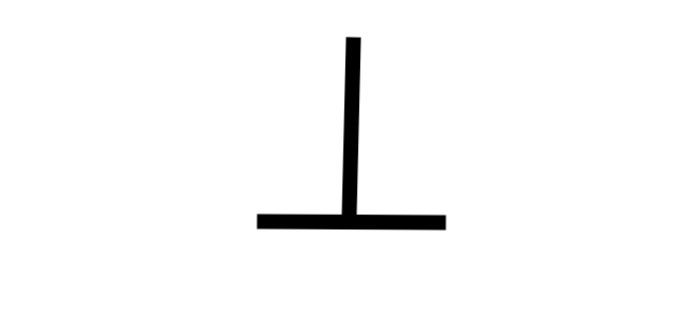
If two components are to be arranged with guaranteed perpendicularity to each other, this must be defined with the intended symbol. DIN ISO 1101 offers the square with an integrated, inverted T for this purpose.